USD
 KES - Kenya
 UGX - Uganda
 TZS - Tanzania
 RWF - Rwanda
 NGN - Nigeria
 ZAR - South Africa
 USD - Zimbabwe
 GHS - Ghana
 ETB - Ethiopia
 ZMW - Zambia

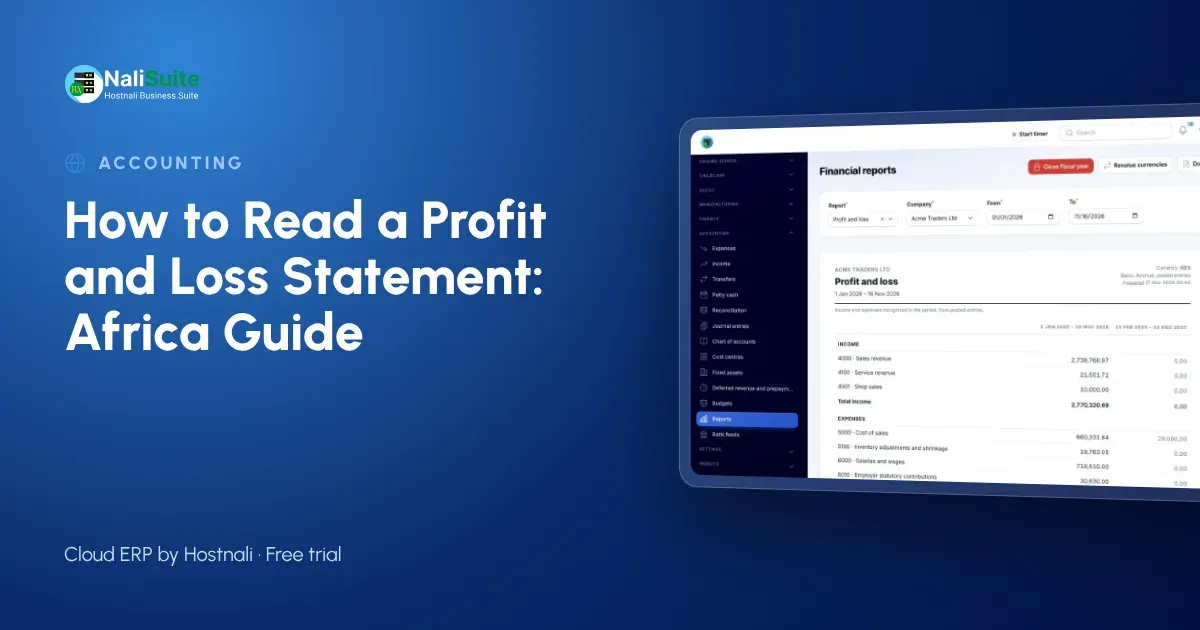
Across Africa, millions of small businesses judge their performance by what is left in the till, the bank account or the mobile money wallet at the end of the day. It is a natural habit, and it is misleading. Cash moves for many reasons: a customer settling an old invoice, a loan coming in, stock bought for the season, money taken out for the family. Profit is something else, and the profit and loss statement (P&L) is where you find it.
This guide is written for owners anywhere on the continent, whether you sell in naira, shillings, cedis, rand or dollars, and whether you trade in one country or several.
What the P&L is for
The P&L, also called the income statement, answers one question over a chosen period: did the business earn more than it cost to run? It counts a sale when it is made, not when the customer pays, and a cost when it is incurred, not when you pay the supplier. That makes it a fair picture of performance, but not of cash. Read it alongside a cash view; our cash flow tips for African businesses explain how.
The lines, in order
- Revenue. Sales for the period. Where you are registered for VAT or a similar sales tax, the tax you collect is excluded: it belongs to the tax authority.
- Cost of sales. The direct cost of the goods or materials you sold.
- Gross profit. Revenue minus cost of sales.
- Operating expenses. Salaries, rent, utilities, fuel and backup power, transport, data and airtime, mobile money and bank fees, marketing, repairs, professional fees and depreciation.
- Operating profit. Gross profit minus operating expenses.
- Finance costs. Interest on loans and overdrafts.
- Exchange gains and losses. For businesses that import, export or hold foreign currency.
- Tax. The income tax charge, worked out with your accountant under your country’s rules.
- Net profit. What is left for the owners.
Turning the lines into four ratios
| Ratio | Formula | What it tells you |
|---|---|---|
| Gross margin | Gross profit ÷ revenue | How much of each sale remains after the product itself |
| Operating margin | Operating profit ÷ revenue | Whether the business model works |
| Staff cost ratio | Staff costs ÷ revenue | Whether the team is sized for the sales |
| Interest cover | Operating profit ÷ finance costs | Whether you can carry your debt |
Ratios travel well. They let you compare months when prices are rising, compare branches of different sizes and even compare operations in two countries without worrying about exchange rates.
Comparing periods
Every P&L needs something to compare it with:
- The previous month, to catch sudden changes.
- The same month last year, to remove the effect of seasons such as harvests, school terms, holidays and tourist peaks.
- Your budget, to see whether the plan still holds.
Where inflation is high, compare volumes as well as values. Revenue up by a quarter with prices up by a third means you sold less.
Comparing markets
If you trade in more than one country, produce a P&L for each company or market as well as a combined one. Imagine a logistics firm with offices in Nairobi and Kampala. Combined, it shows a modest profit. Split by country, the Nairobi office earns a healthy operating margin and Kampala loses money because two trucks run half-empty on the return leg. The combined view hides the decision that needs making.
For a combined view, convert each company’s results into one reporting currency at a consistent rate, and keep exchange movements on their own line so they do not blur the trading result.
Five habits that keep the P&L honest
- Record every sale, including cash at the counter and mobile money receipts.
- Count stock at the end of every period, so cost of sales is real.
- Keep personal spending out. See our guide on separating business and personal money.
- Show one-off items separately, such as asset sales or insurance payouts.
- Close the month within the first week, so the figures are still useful.
From reading to deciding
A P&L that nobody acts on is just paperwork. After each monthly review, pick one decision:
- Gross margin down? Review prices against the latest supplier costs.
- One expense rising faster than sales? Investigate the invoices behind it.
- A branch or market losing money? Set a deadline to fix it or close it.
- Profit healthy but cash tight? Chase overdue invoices before borrowing.
Producing the P&L without spreadsheets
NaliSuite Accounting posts every invoice, supplier bill, payslip and stock movement to the books as you work, so the profit and loss statement, balance sheet and cash flow statement are always ready, with earlier periods for comparison. Country packs load a local chart of accounts and taxes, multi-company support keeps each country or branch separate while giving you a combined view, customers can pay by mobile money or card, and bank and mobile money reconciliation keeps the books in line with your statements.
Frequently asked questions
Is a profit and loss statement the same as an income statement?
Yes. Different countries and accountants use different names for the same report.
Why is my profit different from my cash?
Profit counts sales and costs when they happen. Cash moves with customer payments, stock purchases, loans and owner’s drawings.
How do I compare businesses in two countries?
Use ratios such as gross and operating margin, or convert both P&Ls into one reporting currency at a consistent rate.
Who works out the tax line?
Your accountant, under the rules of the country where the business is taxed.
Try NaliSuite
Read your profit and loss every month, for every branch and every country. NaliSuite starts at $2.10 a month with a free trial. See the plans.